
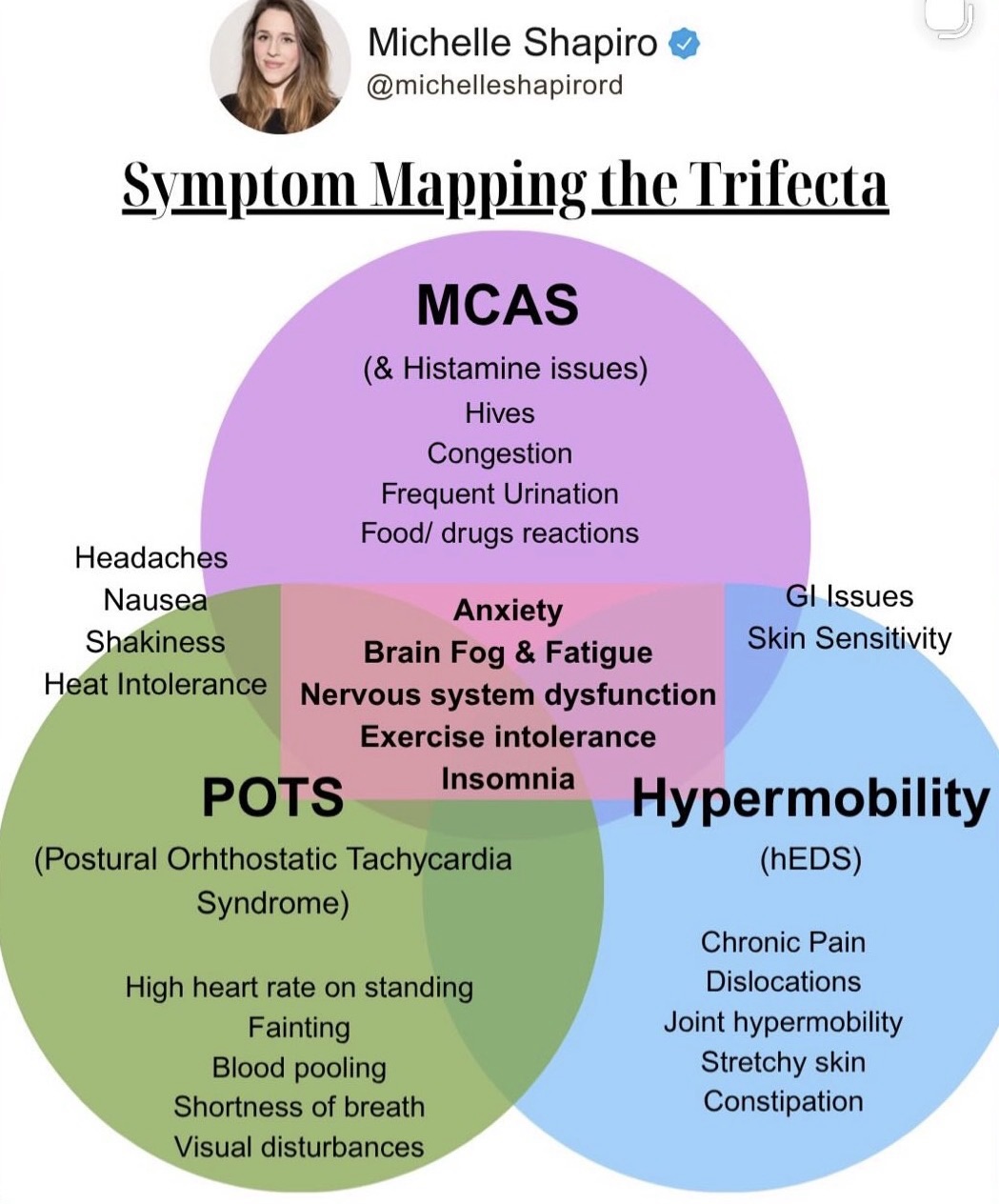
There’s a combination of conditions that many chronically ill people like me know all too well: POTS, EDS, and MCAS. I have written about each of these and my experiences with them in previous blogs, however, there is research being conducted today as to how these three are related.
Some call it “the trifecta” or the “triad”. When you speak to others suffering from one of these conditions, most often you will find that they have been also diagnosed with the two others. Research is still catching up, but for those of us living it, the overlap feels the like closest explanation as to why these symptoms occur and the similarities between them.
For me, it has looked like years of symptoms that never really fit into one diagnosis. In my previous blogs, I have talked about how my medical journey has been treacherous, confusing, and very long. Essentially living with a nervous system that feels stuck in survival mode. I battle constant dizziness, exhaustion, adrenaline surges, stomach issues, pain, flushing, sensitivities, instability, and the frustrating reality that every part of my body somehow seems strangely reactive to “something”. One condition aggravates another, which aggravates another, until your body feels like a domino effect you can’t stop and you’re flat on your back.
Quick review of POTS, hEDS, and MCAS
Postural Orthostatic Tachycardia Syndrome (POTS) affects the autonomic nervous system which is responsible for regulating things your body should automatically know how to do, like heart rate, blood pressure, temperature regulation, and circulation. For many of us, standing up can feel like running a marathon. The dizziness, tachycardia, fatigue, brain fog, fainting, and adrenaline dumps aren’t just “being tired.” They can completely alter an entire day or week.
Ehlers-Danlos Syndrome (EDS), particularly hypermobile EDS, which affects connective tissue throughout the body. Connective tissue is everywhere. Joints, blood vessels, skin, organs. Often seen as a lack of collagen being produced but it actually isn’t. Collagen is being produced, but is faulty and weak, leading to connective tissue problems.
Lastly, Mast Cell Activation Syndrome (MCAS), which can make the body react as though it’s under attack constantly. Histamine intolerance, allergic-type reactions, flushing, swelling, food sensitivities, itching, GI symptoms, breathing issues, medication reactions…all because my mast cells are hyper-reactive and erratic but no idea why.
The difficult part is that these illnesses don’t exist in isolation. They layer on top of each other having similar symptoms. How can I identify what illness or part of the body is in a flare when they overlap? I don’t really. Which is exactly why this research is essential to people like me.
Research has started recognizing the overlap more frequently. Some studies have found significantly higher rates of MCAS in patients with both POTS and EDS compared to the general population.
One of the strongest links is connective tissue dysfunction in EDS, which may affect blood vessels and circulation, causing blood pooling and forcing the body to compensate with the rapid heart rate and autonomic dysfunction seen in POTS. Researchers also believe mast cells may play a role in nervous system dysregulation. Chemicals released during mast cell activation, like histamine, can affect blood vessels, heart rate, inflammation, and nerve signaling, potentially worsening symptoms like dizziness, flushing, GI issues, palpitations, and adrenaline surges.
Some experts are also exploring whether there may be shared genetic, neurological, or immune system pathways connecting all three conditions. While the exact biological relationship is still unknown, the overlap is becoming increasingly difficult for patients and researchers to ignore.
They are exploring whether:
- Certain collagen abnormalities affect immune behavior
- Mast cells interact with connective tissue directly
- Shared genetic pathways influence autonomic dysfunction
- Any links to small fiber neuropathy, neuroinflammation, abnormal immune signaling, and altered connective tissue signaling
Many researchers acknowledge there’s still debate because diagnostic criteria, especially for MCAS and hypermobile EDS, can vary widely between specialists.
Some argue:
- MCAS is over diagnosed because symptoms are broad
- Hypermobile EDS criteria are inconsistent
- Dysautonomia symptoms overlap heavily with mast-cell symptoms
Regardless of the debate, patients are living this reality every day.
One of the hardest parts of these illnesses isn’t just the symptoms themselves. It’s the constant burden of trying to prove them. Explaining why your body reacts unpredictably. Why you can look fine one day and completely nonfunctional the next. Why basic tasks become overwhelming. Why a “normal” schedule feels impossible.
There’s also grief that comes with it. Grief for the version of yourself you thought you’d be by now. Grief for spontaneity. For energy. For how easy life seems to feel for other people. Grief for the amount of time spent at appointments, researching symptoms, fighting insurance, managing medications, and trying to survive in a body that feels constantly overstimulated and under-supported. Living with chronic illness is a full-time job, 24/7.
At the same time, there’s an entire community of people quietly fighting similar battles. People learning how to adapt. People advocating for themselves despite medical gaslighting. People piecing together answers after years of being dismissed.
All of that matters because, while research may still be evolving, our experiences are real. The exhaustion, the pain, and the fear, but even more so, the resilience it takes to keep going anyway.
Thanks for reading.