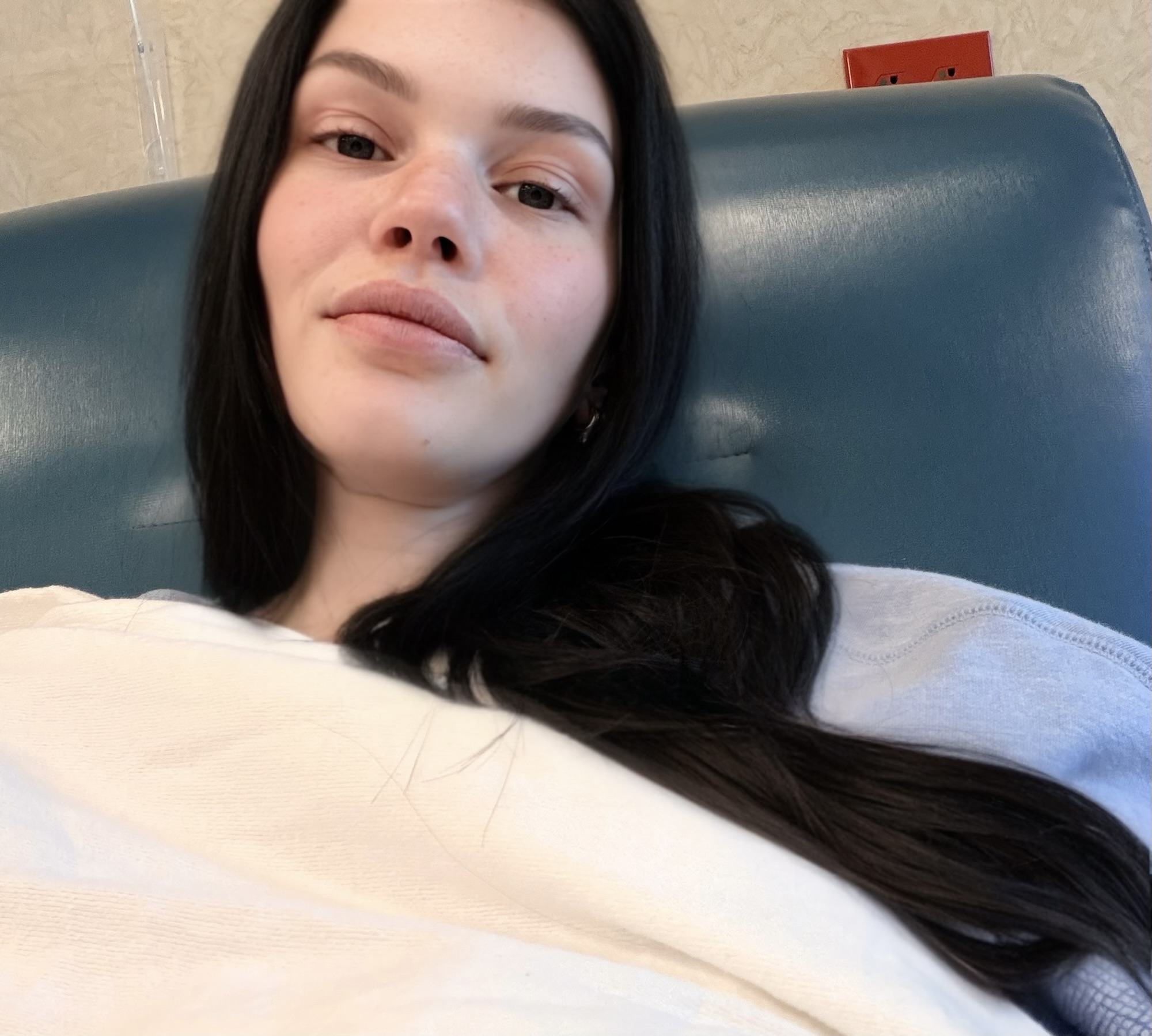
Ohhhhh boy. I feel so weird saying that I wish the results were different. This three decade long journey has never been easy, and it definitely has never been predictable.
I started genetic testing earlier this year to try to understand the entire me. For all of these years, nothing has ever been easy to diagnose, let alone understand. Most tests came back normal and doctors would tell me it’s psychological because all their tests they ran were negative. My brain was making this up and they couldn’t help me.
Over the last 3 years, my family, my doctors, and I have noticed changes in different ways that seem to be more of a systemic problem. My skin became extremely sensitive, new allergies formed, and bruising or scarring from something that should not cause that much damage was happening all the time. I couldn’t keep incisions closed, often breaking the stitches that were in place after surgery. I had my cervical spine stimulator literally rip off my spinal cord twice in 2023 because something “weird” was happening. My incisions would open, revealing an unhealed wound with dangerous consequences. No matter what I did, I would have unhealed, open incisions and it didn’t matter how much time had passed or what type of closure was used. As my surgeon said,
“this has never happened in my entire career”.
These type of problems started to sound familiar, as I was in many support groups with others like me. Ehlers Danos Syndrome (EDS) had to be the culprit. EDS is a group of genetic conditions that primarily affect connective tissue, specifically collagen, leading to hypermobile joints, stretchy and fragile skin, easy bruising, pain, and many other complex symptoms. There are 13 different forms of EDS, with Hypermobile EDS (hEDS) being the most common, Vascular EDS (vEDS) the most dangerous, and others so rare that they are often not reported. 12 of the 13 types can be linked to a genetic mutation, however, hEDS still hasn’t been connected to a specific mutation yet.
With this type being the most common, there is an emphasis on elimination, which is then followed by a very specific and complex evaluation through a medical provider. In order to be a confirmed patient with hEDS, there are specific boxes and symptoms that must be present and checked.
The more people I conversed with, the more doctors I met with, EDS was going to be it. There was no way I couldn’t have this and my “overarching umbrella” that has sent me down this path since I was 8 would finally be identified. I really didn’t expect anything else and I definitely didn’t prepare myself to be let down. I am sad, I am grieving. I am feeling defeated. I am also very confused as to why something like this would make me anything but happy? I get to say that something was a definitive no! That’s huge! I have struggled to wrap my head around this, but I knew I needed time to process.
I have taken a lot of time to acknowledge how unsettling this actually is. I am confused by these feelings but I also need to understand that my “internal map” has been ripped away after convincing myself it made sense. During this time of processing, I wrote out a few things that I needed to recognize and share before I moved on.
1. I am not failing.
A medical evaluation is not a pass/fail test of whether you’re sick enough or whether your experience is valid.
Some diagnoses are a clinical construct and not always a perfect diagnosis. Medicine uses a “bucket” when your body behaves abnormally, symptoms are widespread, and genetics have been ruled out. All of this doesn’t mean nothing is wrong or my symptoms were misinterpreted, it only means that that particular label may not be the best fit.
2. The belief that “everything was explainable” mattered.
I am grieving the loss of coherence, not just a diagnosis. I had a framework, a narrative, and a way to explain my body to myself and others. Now, it feels like that scaffolding collapsed, and I am left thinking:
“If it’s not this… then what the hell is happening?”
That grief is real and it’s not dramatic. It’s a very normal response to uncertainty after doing everything right.
3. My lack of hypermobility ≠ lack of connective tissue dysfunction.
Like I said above, a hEDS diagnosis has to meet certain requirements. For me, I don’t notice my joints as super flexible, it’s actually the opposite. My hips, knees, shoulders, ankles are SO stiff, often needing to “pop” them to be comfortable. So how does that fit into a hypermobile category? Apparently, it does.
This is where medicine doesn’t communicate well. Many people have connective tissue fragility without classic hypermobility, autonomic dysfunction (POTS), GI dysmotility (gastroparesis), mast cell issues, chronic pain, fatigue, and temperature dysregulation. These systems are linked by connective tissue, but hypermobility is only one outward expression and often the least relevant later in life. That’s new to me.
4. When genetics and autoimmune are negative, that does NOT mean it’s a “mystery illness”.
It usually means a functional connective tissue disorder or a neuro-immune-autonomic condition (medicine doesn’t have great names for these yet and doesn’t show up cleanly on labs…they show up in patterns).
So how do I, after acknowledging the above, move forward? I need to stop chasing the “perfect name” because the management plan is what matters the most! I need to ask myself:
What systems are affected?
What makes symptoms worse?
What stabilizes things?
That’s where progress actually happens. I need to focus on what’s real right now. I DO have autonomic dysfunction, GI dysmotility, chronic multisystem symptoms, and real functional limitations. Those don’t disappear because a category doesn’t fit neatly.
I need to let myself be confused. Let myself be sad. Let myself feel anything I am feeling without blaming myself. Instead of feeling like I am regressing in my journey, I am at a transition point and not a dead end. I am not imagining patterns that aren’t there. I didn’t convince myself into a diagnosis. I followed evidence, symptoms, and medical guidance.
That gap? The one between lived experience and diagnostic certainty? That is where so many chronically ill people end up. I am not alone, even though it feels isolating.
Besides, who wants to be “normal” and fit inside the boxes everyone else is in anyway? *Wink*
Thanks for reading.