Even though living with CRPS makes you hyper-aware of every potential injury, every environment, every possible risk, I never expected that a simple tetanus shot, something routine before heading off to college at CSU, would be what sent my CRPS to new places. I remember the shot itself hurting and being sore for a few days, but soon after, I started feeling that intense, burning pain down the back of my right arm. It was obvious that it was the unmistakable CRPS pain: burning, electric, and relentless.
At first, I brushed it off and tried to address it with the “tools” I have learned over the years, but as time went on, it intensified. I hadn’t even thought about getting a stimulator for my legs yet, let alone undergone the surgery for one, so this new arm pain complicated everything. By early 2011, I finally had my stimulator in place for my legs and was deep in recovery, healing, grateful, and cautiously hopeful. Unfortunately, the pain in my arm never went away. It grew worse, spreading from my upper arm down through my forearm, into my hand, and finally my thumb.
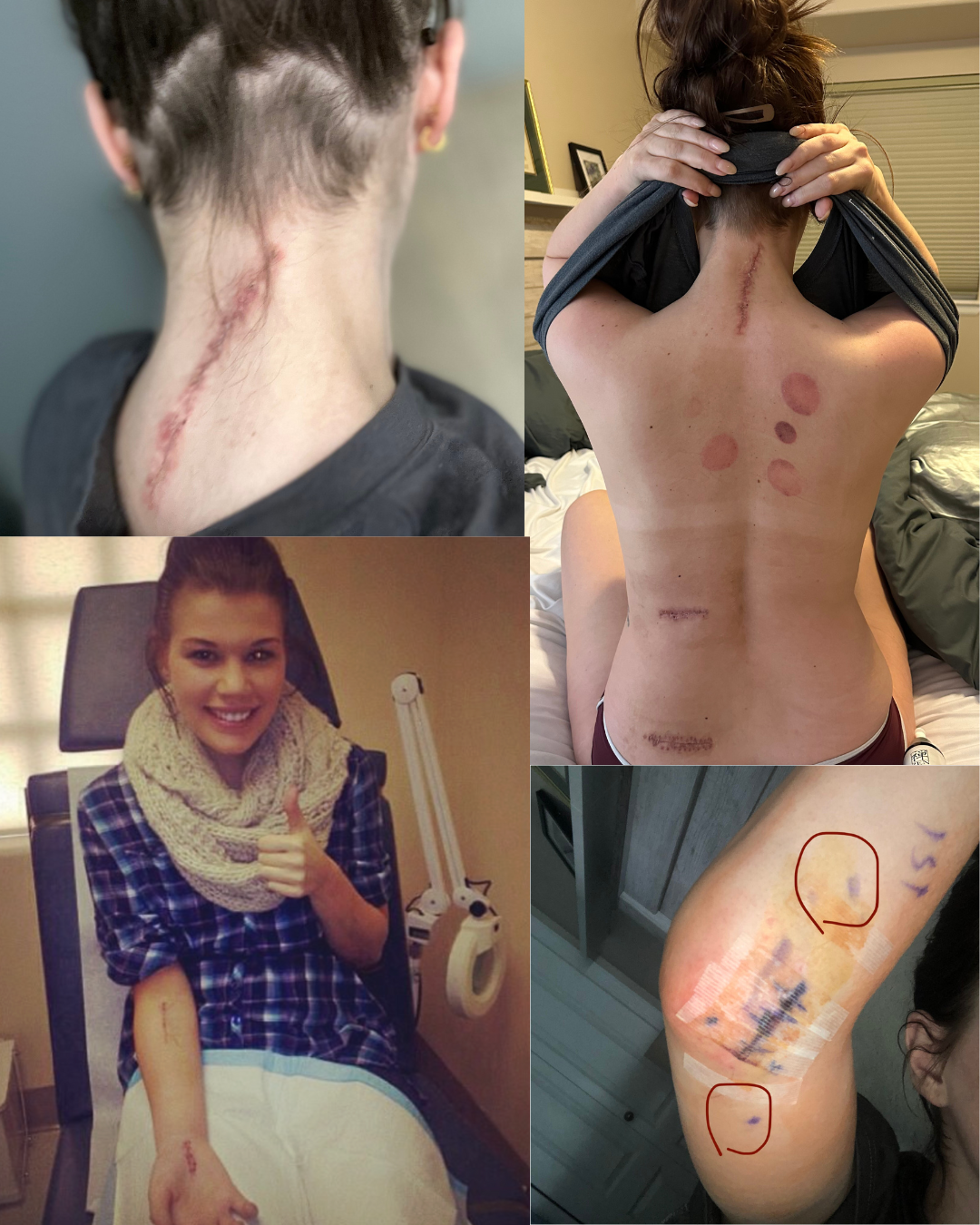
I started seeing a different pain doctor, the same one who had given me my week-long stimulator trial for my legs, and we began exploring new treatments. Alongside CRPS, I was now dealing with severe neuropathy, tingling, and numbness in my hand and fingers, and we tried everything: nerve blocks, injections, and ketamine infusions. Eventually, the treatments stopped working and the physical trauma to my hand was substantial. The repeated injections caused serious damage to my skin and hand, so much so that I almost ended up with a permanently nonfunctional hand. Looking back, the treatments were careless and caused more harm than good, but I was desperate. I wanted relief and I wanted my life back. I was willing to try anything.
Another pain doctor I had known for years performed dozens of nerve blocks over time, trying to calm those stubborn nerves. He had always gone above and beyond for his patients, and he was determined to help me find relief. He suggested something I never expected. He wanted to transform his outpatient clinic in Golden, Colorado into a week-long “pain holiday” experience, just for me. Looking back, I can hardly believe that office went to that magnitude doing something they never actually do in practice.
The process required so much planning, and insurance obviously had to approve it first. My doctor needed an inpatient room, day and night nurses, a reworked medical plan, endless supplies, and a completely different operational setup. I still can’t explain how grateful I was to have a doctor willing to try new things (Shoutout to Dr. Brown!).
While I didn’t walk out of that experience pain-free and in remission, I did feel some relief, enough to give me hope again. But over the next few years, despite every new treatment, medication, and nerve block, the pain continued to spread and refused to back down. Finally, on November 3, 2014, I underwent my second spinal cord stimulator surgery, this time for my arms. Fittingly, that same day happened to be Color the World Orange Day, the global awareness day for CRPS. Even more special, the City and County of Denver had officially proclaimed the first Monday of every November as “Color the World Orange Day” shortly before. It felt like fate, and I was at peace with getting another implant.
This surgery was so much scarier. The stimulator was placed in my cervical spine, right at my neck, a much smaller, more delicate space. My doctor warned me recovery would be longer and more intense, and he was right. After surgery, I was admitted for observation and wasn’t allowed to move my head at all. Every small move, even sitting up, had to be done in a very specific way. The pain from that surgery was astronomical: the headaches, the muscle spasms, the neck tension.
In my post-op appointment, Dr. Barolat explained he had to literally take part of my vertebrae to get the electrodes onto my spine. To this day, I still have a strange hump to my neck that I have always been insecure of. It was a physical reminder of that surgery, and I continue to deal with chronic neck pain and muscle tightness because of it. But even through all of that, I still knew: this surgery was my second chance at a normal life.
But of course, my story didn’t end there. As my recovery continued, more challenges appeared in the form of four nerve compressions in different parts of my right arm. I was diagnosed with Thoracic Outlet Syndrome, Carpal Tunnel Syndrome, Pronator Syndrome, and Cubital Tunnel Syndrome. On their own, each of these are relatively straightforward to treat, but with my history of nerve damage and neurological sensitivity, my body didn’t respond like most.
I underwent surgeries to release each compression. We weren’t sure if it was too late to regain full function, but I did. Against all odds, I did. About a year and a half later, the pain, the tingling, and the numbness that had taken over my hand began to fade and my nerves essentially “grew back”. Today, my right arm is about 95% better, occasionally having an angry nerve, but its always temporary, and my CRPS remains well-managed thanks to the success of my implants and the doctors who refused to give up on me.
From Dr. Barolat, Dr. Merritt, Dr. Slover, Dr. Brown, the other Dr. Brown, Dr. Krutsch, Dr. Burke, Dr. Oh, Dr. Annest, Dr. Sanders, Dr. Yi, Dr. Disorbio, and every nurse, PA, surgical assistant, anesthesiologist, infusion center, physical therapist, pharmacist, device rep, psychologist, and more…I will forever be grateful for those who believed in me, who fought for me, and who treated me like a human being. Their dedication, still to this day, gave me back pieces of my life I thought were gone forever. Your accolades and training and talent are admirable, but I will always remember the kindness, the hugs, the time, and the words that kept me going. I have the greatest family, and I know everyone says that.
My Mom – my advocate, my voice, the fighter. Never once gave up, and still hasn’t to this day. She is always fighting for answers, for respect, and understanding. I swear she could educate doctors with how much research and fighting she has done. She, too, was diagnosed with CRPS shortly after me, but you wouldn’t know it. Her dream is whatever I dream for myself, and I can never thank her enough. I have learned so much from her and if I grow up to be a sliver of who she is, I will be blessed.
My dad – the pillar, the strength, the leader. He didn’t need to say much because I could feel it. He was the strong one, but at the same time, he was soft and gentle. I don’t have my own children, but I can feel how he breaks when we any of us are struggling. He always stood beside me, unwavering and solid, leading our family in love and honor.
Alex and Lily – My protectors, my laughter, the source of closeness. Growing up, it sometimes felt like my illnesses took away pieces of their childhood. The spontaneity, the normalcy, the lightness of being kids. Never once did they make me feel like a burden, judged, or misunderstood. They showed me what unconditional love really looks like. I have always loved being the middle child because I now have two built-in best friends, each holding me up in their own way when life gets heavy. I am endlessly proud of them; of their strength, their kindness, and their tenacity to keep building better, fuller lives for themselves. Their determination reminds me every day what resilience truly looks like.
My CRPS journey is always being written, page by page, flare by flare, diagnosis after diagnosis. Living with CRPS means there is never truly a finish line, only chapters of progress, setbacks, and adjustments. 2023 was one of the hardest years yet for my body and my stimulators, a true nightmare that tested everything I thought I had already overcome, but that is a story for another day. For now, I am holding onto gratitude, resilience, and the reminder that healing isn’t a destination but a lifelong journey.
Thanks for reading.